Empower Ethical Leadership & Governance Strategies

Ethical Leadership Governance

Building Ethical Leaders. Strengthening Ethical Organizations.

Leadership is not merely achieving results.

It is about achieving the right results, for the right reasons, through responsible stewardship of people, culture, and organizational purpose.

Organizations rarely fail because they lack intelligence or technical expertise. More often, they fail because ethical leadership, governance, accountability, and organizational culture fail to keep pace with growth and complexity.

Our Ethical Leadership Governance services integrate leadership science, organizational psychology, psychometric assessment, organizational diagnostics, and evidence-based governance practices to help organizations build cultures in which ethical decision-making is embedded in everyday leadership rather than reserved for times of crisis.

Whether developing executive leaders, evaluating succession pipelines, strengthening organizational culture, facilitating ethics committees, or designing codes of conduct, the goal remains the same:

To help organizations build leaders worthy of trust.

What is Ethical Leadership Governance?

Many organizations think ethics begins and ends with compliance.


Compliance asks:

"Are we following the rules?"

Ethical Leadership Governance asks:

"Are we making the right decisions even when the rules don't provide the answer?"
Ethics is not simply avoiding misconduct.

It is creating leadership systems that consistently produce responsible decisions, healthy cultures, and sustainable organizational success.

True ethical leadership extends beyond regulatory compliance and legal obligation.

It encompasses:

  • Integrity
  • Accountability
  • Courage
  • Transparency
  • Fairness
  • Stewardship
  • Psychological Safety
  • Responsible Decision-Making
  • Organizational Trust

Ethicist Consulting Services

Ethical Leadership Assessments & Succession Mapping

Evaluate leadership character, integrity, judgment, accountability, courage, emotional intelligence, and ethical decision-making through ethical leadership lens using evidence-based psychometric assessment and executive evaluation methodologies.

Ideal for:

  • Executive selection
  • Promotion decisions
  • Leadership development
  • Succession planning
  • High-potential identification

Ethical Organizational Culture Diagnostics

Healthy cultures rarely emerge by accident.

Through interviews, focus groups, surveys, stakeholder feedback, and organizational diagnostics, we evaluate the ethical climate of an organization to identify cultural strengths, leadership blind spots, and systemic risks before they become organizational crises.

Typical areas include:

  • Organizational trust
  • Accountability
  • Psychological safety
  • Leadership credibility
  • Communication climate
  • Ethical decision-making
  • Organizational justice
  • Cultural alignment

Ethics Policy & Governance Development

Develop or strengthen organizational governance through:

  • Codes of Conduct
  • Codes of Ethics
  • Leadership Standards
  • Organizational Values
  • Ethical Decision Frameworks
  • Leadership Accountability Models
  • Governance Policies
  • Ethics Program Development

Executive Ethics Advisory

Support senior leaders navigating complex ethical decisions involving governance, organizational culture, succession, stakeholder trust, executive accountability, and responsible leadership.

Common engagement topics include:

  • Executive decision-making
  • Governance challenges
  • Ethical dilemmas
  • Leadership accountability
  • Organizational trust
  • Strategic change initiatives

Ethics Committee Facilitation

Provide independent facilitation and advisory support for executive leadership teams, ethics committees, and governance groups seeking structured, evidence-based approaches to organizational ethics and decision-making.

Services may include:

  • Ethics committee facilitation
  • Policy review
  • Governance recommendations
  • Ethical decision frameworks
  • Organizational ethics consultation

Corporate Training & Development

Develop ethical leaders through executive education, workshops, seminars, and organizational learning experiences focused on:

  • Ethical Leadership
  • Responsible Leadership
  • Leadership Character
  • Organizational Trust
  • Psychological Safety
  • Ethical Decision-Making
  • Values-Based Leadership
  • AI Ethics for Leaders
  • Leadership Governance

The Dr. Change Ethical Leadership Governance System™

Phase I — Organizational Ethical Assessment (OEI™)

Purpose:
Evaluate the ethical health, governance maturity, and organizational climate of the enterprise through a comprehensive Organizational Ethics Index™ (OEI).

Primary Activities

  • Organizational Ethics Index™ (OEI) 
  • Ethical culture diagnostics 
  • Governance and policy review 
  • Organizational climate assessment  
  • Stakeholder interviews 
  • Focus groups 
  • Survey administration 
  • Document analysis 
  • Organizational justice evaluation  
  • Psychological safety assessment 
  • Ethical climate analysis 

Primary Deliverable

Organizational Ethics Diagnostic Report identifying systemic strengths, vulnerabilities, governance maturity, and enterprise-level ethical risk.


Phase II — Executive Leadership Evaluation (ELGI™)

Purpose:
Evaluate executive leaders and succession candidates through a triangulated, evidence-based assessment methodology focused on ethical leadership capability.

Primary Activities

  • Ethical Leadership Governance Index™ (ELGI) 
  • Psychometric assessment 
  • Executive interviews 
  • Behavioral interviews 
  • Leadership simulations 
  • Executive judgment analysis 
  • Leadership risk assessment 
  • Critical thinking evaluation 
  • Emotional intelligence assessment  
  • Leadership character evaluation 

Primary Deliverable

Executive Leadership Evaluation Report identifying leadership strengths, ethical competencies, developmental opportunities, and leadership risk factors.


Phase III — Organizational & Leadership Alignment Analysis

Purpose:
Integrate organizational findings with executive assessment data to determine whether leadership capabilities are aligned with organizational needs, strategic priorities, and ethical governance objectives.

Primary Activities

  • Organizational-to-leader alignment analysis 
  • Ethical leadership gap analysis 
  • Leadership capability mapping 
  • Organizational risk synthesis 
  • Executive readiness evaluation 
  • Cross-analysis of OEI™ and ELGI™ findings 

Primary Deliverable

Integrated Leadership Alignment Report highlighting organizational risks, leadership gaps, and strategic priorities.


Phase IV — Succession Planning & Strategic Talent Mapping

Purpose:
Identify, evaluate, and strategically align current and future leaders with organizational roles based upon evidence, organizational needs, ethical leadership capability, and long-term succession objectives.

Primary Activities

  • Succession planning 
  • Leadership pipeline evaluation 
  • High-potential identification 
  • Role-to-leader matching 
  • Executive readiness mapping 
  • Talent portfolio analysis 
  • Strategic workforce recommendations 

Primary Deliverable

Strategic Succession Planning Report identifying recommended leadership placements, succession pathways, and organizational talent priorities.


Phase V — Strategic Governance Recommendations

Purpose:
Provide executive leadership with a comprehensive governance roadmap designed to strengthen ethical leadership, organizational culture, governance systems, and long-term organizational effectiveness.

Potential Recommendations

Leadership Recommendations

  • Executive coaching recommendations 
  • Leadership development priorities  
  • Ethical leadership development plans 
  • Executive mentoring recommendations 
  • Leadership competency development  

Organizational Recommendations

  • Ethical culture improvement initiatives 
  • Organizational diagnostics follow-up 
  • Governance framework enhancements  
  • Policy and Code of Conduct development 
  • Ethics committee recommendations 
  • Decision-making framework implementation 
  • Psychological safety initiatives 
  • Accountability framework improvements 
  • AI governance recommendations 
  • Succession strategy enhancements 

Primary Deliverable

Executive Governance Advisory Report containing prioritized strategic recommendations, implementation roadmap, and long-term governance considerations.


Phase VI (Optional) — Governance Monitoring & Reassessment

This could include:

  • Quarterly governance health reviews 
  • Annual OEI™ reassessments 
  • Executive ELGI™ reassessments 
  • Succession pipeline monitoring 
  • Ethical climate trend analysis 
  • Board advisory briefings


The Dr. Change Ethical Leadership Governance System™

Assess → Evaluate → Align → Map → Govern

This integrated methodology combines organizational diagnostics, leadership science, psychometric assessment, executive evaluation, ethical governance, and succession planning into a comprehensive evidence-based system for helping organizations identify, develop, and strategically position leaders worthy of trust.

Dr. Change Ethical Leadership Governance Index™ (ELGI)

Domain 1: Ethical Character & Identity

  • What it Measures: Stated moral identity, authenticity, alignment of core values, and baseline structural personality traits that drive ethical intent.
  • Core Measures: Integrity, Courage, Accountability, Humility, Openness, and Conscientiousness.
  • The Triangulated Data Matrix:
    • LCIA (Leadership Character Insight Assessment) (Sigma): Directly tracks the virtues of character.
    • NEO PI-3 (Big 5) (Pearson): Specifically focusing on the Conscientiousness (Duty, Achievement Striving), Agreeableness (Straightforwardness, Modesty, Trust), and Openness (Values, Ideas) domains.
    • Structured Executive Biography Interview.

Domain 2: Behavioral Deployment (Ethical Methodologies)

  • What it Measures: How the leader visibly projects influence, communicates expectations, manages teams, and scales organizational values in real-time.
  • Core Measures: Transformational Leadership, Servant/Authentic Stewardship, Ethical Influence, and Collaboration.
  • The Triangulated Data Matrix:
    • MLQ-6S / MLQ-360 (Multifactor Leadership Questionnaire) (Mind Garden): The absolute gold-standard validation for your dissertation framework on transformational leadership.
    • ALQ (Authentic Leadership Questionnaire) (Mind Garden): Tracks self-awareness and balanced, ethical processing.
    • LSP-R (Leadership Styles Profile - Research Edition) (Sigma): Validates day-to-day operational execution.

Domain 3: Ethical Emotional Intelligence (Ethical EQ)

  • What it Measures: The interpersonal and intrapersonal engine required to withstand moral distress, read stakeholders, and navigate emotionally volatile compliance issues without fracturing relationships.
  • Core Measures: Self-Regard, Empathy, Impulse Control, Reality Testing, and Stress Tolerance under high moral high-stakes pressure.
  • The Triangulated Data Matrix:
    • EQ-i 2.0® / EQ 360® (Multi-Health Systems): Tracks core functional emotional intelligence.
    • MEIA-R (Multidimensional Emotional Intelligence Assessment - Revised) (Sigma): A highly structured, personality-based measure of emotional capacity that pairs perfectly with the NEO.
    • EQ 360® Degree Stakeholder Validation.

Domain 4: Ethical Cognitive Judgment & Reasoning

  • What it Measures: Cognitive complexity, logic, and problem-solving capability when faced with structural ethical dilemmas where laws or rules do not provide a clear answer.
  • Core Measures: Complex Problem Solving, Systemic Reasoning, Cognitive Flexibility, and Objectivity under Ambiguity.
  • The Triangulated Data Matrix:
    • Raven's Progressive Matrices (Advanced) (Pearson): Evaluates non-verbal abstract reasoning and systemic fluid intelligence (your clean, elite Level C replacement for Watson-Glaser).
    • Dr. Change Proprietary Ethical Dilemma Simulations: Custom behavioral case scenarios mapping state-level regulations or industry crises.
    • Document & Policy Case Study Defenses.

Domain 5: Leadership Conduct Risk & Derailment (The Shadow Domain)

  • What it Measures: The toxic dark side of leadership—behavioral blind spots, structural vulnerabilities, and underlying neuroses that cause ethical erosion under prolonged stress.
  • Core Measures: Narcissism, Machiavellianism, Defensiveness, Abuse of Power, and Regulatory Vulnerability.
  • The Triangulated Data Matrix:
    • Sigma LDR (Leadership Development Report) (Sigma): Pinpoints structural management gaps and behavioral liabilities.
    • NPQ (Nonverbal Personality Questionnaire) (Sigma): Circumvents self-report bias to find hidden behavioral tendencies.
    • Dr. Change "Shadow Break" Structural Risk Interview. A structured executive interview designed to explore leadership history, behavioral patterns, ethical decision-making, accountability, conflict management, and responses to high-pressure organizational situations.


Sample Executive Report Summary: The ELGI Scorecard

Instead of giving you five separate psychometric charts, your final output is an enterprise risk score, delivered via a professional dashboard.

Overall ELGI Score: 87/100 (High-Integrity Governance Baseline)

  • Domain 1: Ethical Character & Identity ─── 92/100 (Excellent virtue alignment)
  • Domain 2: Behavioral Deployment ─── 85/100 (Strong transformational presence)
  • Domain 3: Ethical Emotional Intelligence ─── 89/100 (High stress tolerance/empathy)
  • Domain 4: Cognitive Judgment ─── 91/100 (Elite systemic problem-solving capacity)
  • Domain 5: Conduct Risk Mitigation ─── 74/100 (Warning: Elevated stress-induced derailment vulnerabilities)

🏛️ The Dr. Change Organizational Ethics Index™ (OEI)

The Dr. Change Organizational Ethics Index™ (OEI) shifts the focus from individual psychology to macro-systemic health. It allows the audit of an entire enterprise, identifies structural vulnerabilities, and provides a single readiness score to executives and the Board of Directors by quietly infusing ancient principles into its structural architecture; the index has an unassailable philosophical core. 


Domain 1: Institutional Governance & Compliance (Inspired by Truth & Order)

  • Strategic Intent: Evaluates the foundational legal, moral, and structural systems of the enterprise. It tests whether internal truth-telling mechanism are protected and if the formal "laws" of the company align with its declared mission.
  • OEI Sub-Metrics:
    • Policies & Ethics Infrastructure: Robustness of the written Code of Conduct, Code of Ethics, and transparency of executive disclosures.
    • Whistleblower & Reporting Protection: The absolute safety, structural anonymity, and corporate integrity of reporting mechanisms.
  • Data Synthesis Sources: Document reviews of policy charters, past litigation audits, internal hotline data, and structural compliance interviews.

Domain 2: Cultural Climate & Equity (Inspired by Justice & Harmony)

  • Strategic Intent: Measures how fair and harmonious the organization feels to its employees. It evaluates whether the enterprise acts with institutional justice or if systemic biases create organizational friction and moral distress.
  • OEI Sub-Metrics:
    • Organizational Justice: Fairness in performance evaluations, compensation equity, and promotional tracks.
    • Culture & Moral Climate: Whether the workplace climate actively encourages, rewards, and protects ethical behavior rather than purely punishing misconduct.
  • Data Synthesis Sources: Organization-wide anonymous climate surveys, focus groups across varying tiers of the hierarchy, and historical HR turnover data (SHRM-SCP metrics).

Domain 3: Organizational Trust & Psychological Safety (Inspired by Reciprocity & Trust)

  • Strategic Intent: Diagnoses the baseline human tissue of the organization. It tracks the mutual exchange of trust between leadership and the workforce, evaluating whether power dynamics are collaborative or toxic.
  • OEI Sub-Metrics:
    • Psychological Safety: The freedom of employees to challenge the status quo, voice dissent, or admit mistakes without fear of career execution or humiliation.
    • Institutional Trust: The transparency of executive communication and the workforce's belief in leadership credibility.
  • Data Synthesis Sources: Psychological safety assessments, stakeholder 360 feedback loops, and open-ended text mining from cultural audits.

Domain 4: Decision Governance & Accountability (Inspired by Balance & Responsibility)

  • Strategic Intent: Examines the engines of action. It checks whether day-to-day decision-making processes balance financial metrics with human ethics, ensuring accountability is held at all levels.
  • OEI Sub-Metrics:
    • Decision Systems & Ethical Screening: The presence of formal, rigorous risk frameworks used before rolling out products, entering markets, or changing operational structures.
    • Accountability Frameworks: Clear definitions of who owns operational risk, and whether executives face the same consequences for failures as frontline staff.
  • Data Synthesis Sources: Strategic decision-case reviews, leader risk mapping interviews, and project management (PMP) process audits.

Domain 5: Future-Proof Continuity (Inspired by Stewardship)

  • Strategic Intent: Evaluates the organization’s long-term moral legacy and technological sustainability. It protects the company from future leadership derailment and emerging algorithmic risks.
  • OEI Sub-Metrics:
    • Ethical Succession Planning: Ensuring future candidates are selected based on ethical competency, emotional intelligence, and character—not just short-term financial performance.
    • AI Governance & Tech Ethics: The structural review of automated diagnostic data, algorithmic bias mitigation, and data privacy safeguards (AIGP alignment).
  • Data Synthesis Sources: Deep-dive succession pipeline assessments, board readiness reports, and technology/algorithmic risk reviews.


Sample Executive Report Summary: The OEI Corporate Scorecard

When delivering this report to executives or boards, we convert qualitative human chaos into a definitive enterprise asset valuation.

Overall OEI Rating: 79/100 (Operational Vulnerability Level: Moderate)

  • Domain 1: Institutional Governance & Compliance ─── 88/100 (Strong legal compliance infrastructure)
  • Domain 2: Cultural Climate & Equity ─── 81/100 (Healthy fairness baselines)
  • Domain 3: Organizational Trust & Psychological Safety ─── 62/100 (Warning: Low psychological safety limits innovation/whistleblowing)
  • Domain 4: Decision Governance & Accountability
     ─── 84/100 (Structured risk screening protocols are functional)
  • Domain 5: Future-Proof Continuity ─── 76/100 (Vulnerable: Lacks ethical guardrails in AI pipeline & succession selection)


The Strategic Value 

  1. A Premium B2B Asset: With the ELGI diagnosing individual leaders and the OEI diagnosing the entire system, Dr. Change has a closed-loop proprietary framework. We can audit the organization, find the cultural rot, and then map out the exact leadership profile needed to fix it.

"The OEI is heavily grounded in contemporary organizational psychometrics, change management, and governance standards. However, it is philosophically inspired by multiple ancient traditions of civic order and cosmic balance. We believe that true institutional health requires a balance of truth, justice, reciprocity, and stewardship to remain sustainable over centuries." ── Dr Change


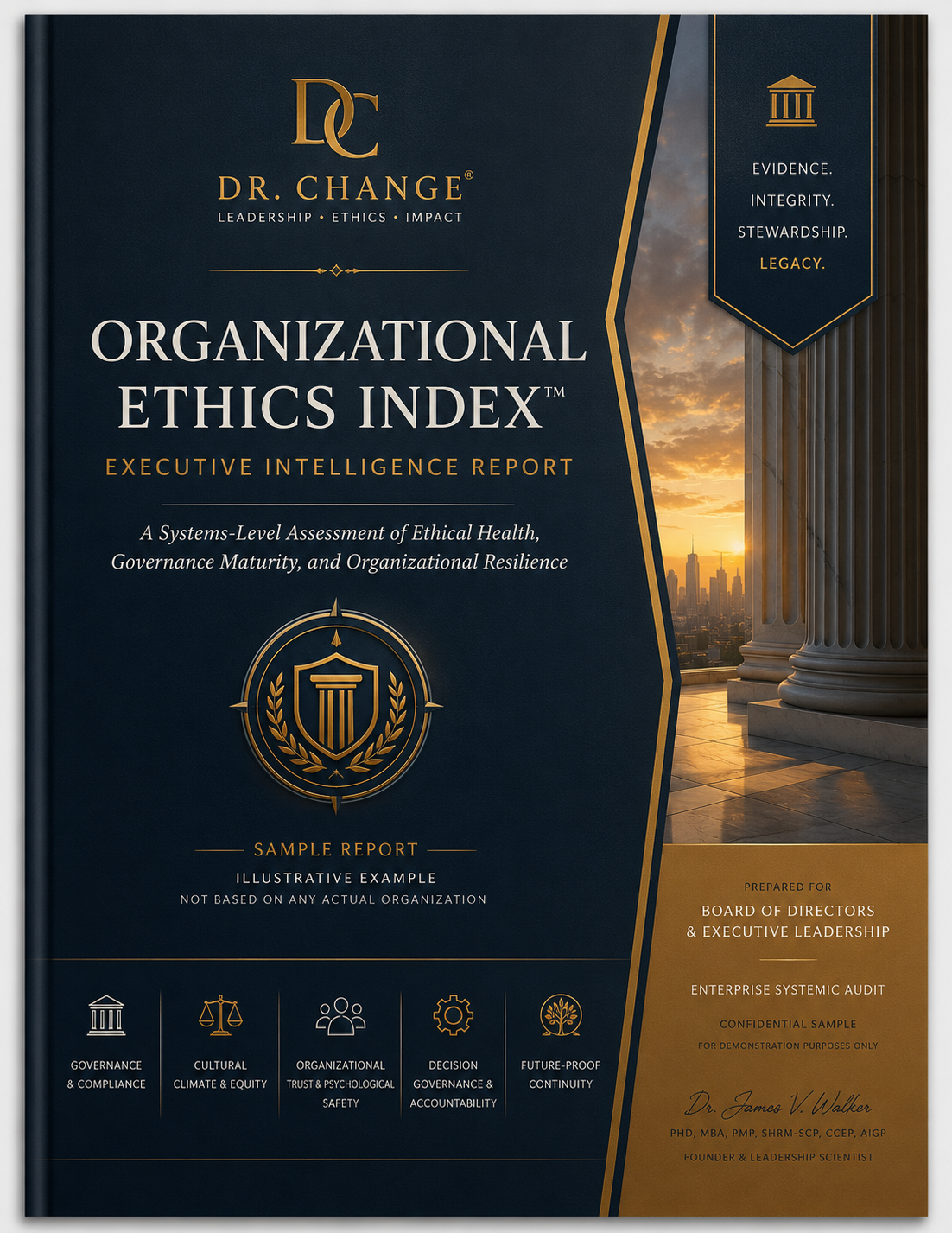
Preview an Executive Intelligence Report

Experience the level of insight delivered through the Dr. Change Organizational Ethics Index™ (OEI).

This sample executive report illustrates how organizational diagnostic data is transformed into board-ready intelligence, highlighting governance strengths, cultural vulnerabilities, enterprise risks, and strategic recommendations.

Rather than simply presenting assessment results, the OEI synthesizes behavioral science, organizational diagnostics, and governance analysis into actionable executive guidance designed to support informed leadership decisions.

Download the Sample Executive Intelligence Report

Universal Principles

Ethical Compass

Philosophical Foundations

The Dr. Change Ethical Leadership Governance Framework™ is informed by evidence-based leadership science while drawing inspiration from enduring philosophical traditions that have emphasized integrity, justice, balance, stewardship, and responsible leadership for thousands of years.

One such influence is the ancient principles, representing truth, justice, harmony, balance, reciprocity, and right order. while grounded in modern organizational psychology and leadership research. These timeless ideals continue to provide meaningful perspective on ethical governance today.

The Six Principles of Ethical Leadership Governance

Truth

Justice

Balance

Stewardship

Accountability

Legacy

Why Ethical Leadership Matters

Organizations rarely collapse overnight.

More often, failures begin with small compromises:

  • Ignored warning signs
  • Poor succession decisions
  • Unhealthy cultures
  • Misaligned incentives
  • Leadership blind spots
  • Erosion of trust
  • Ethical complacency

Strong governance helps organizations identify these risks before they become crises.

Ethical Leadership Governance is not simply about preventing misconduct.

It is about creating organizations where integrity, accountability, sound judgment, and responsible leadership become sustainable competitive advantages.


At Dr. Change, ethical leadership is viewed not as a compliance requirement, but as a strategic leadership capability.

Through evidence-based assessment, organizational diagnostics, succession planning, executive education, and governance consulting, organizations can develop leaders who earn trust, inspire confidence, and steward their organizations with integrity.

Organizations entrust leaders with authority.

Ethical Leadership Governance ensures that authority is exercised with integrity, wisdom, accountability, and responsible stewardship.

Because leadership is not simply about who has authority.

It is about who deserves it.

Strengthen the integrity of your leadership, culture, and governance.

Whether you're evaluating executive talent, strengthening organizational culture, developing ethical governance frameworks, or preparing for the future of responsible leadership, Dr. Change provides evidence-based insight to help organizations make confident decisions.

Begin a confidential consultation today.


E-mail: support@dr-change.com


Dr. Change

Leadership Ethicist • Ethical Leadership Governance • Organizational Diagnostics • Executive Advisory

* Indicates required fields
Thank you! We will get back to you as soon as possible.

©Copyright 2025 Dr Change LLC. All rights reserved.

Information icon

We need your consent to load the translations

We use a third-party service to translate the website content that may collect data about your activity. Please review the details in the privacy policy and accept the service to view the translations.